




Window Glass Repair: Professional Techniques for Restoring Strength and Clarity
Window glass repair looks straightforward from the outside, a crack gets fixed, a pane gets replaced, and the window looks normal again.
What actually happens between the assessment and the finished result involves a range of techniques that vary depending on the type of glass, the nature of the damage, and what the finished repair needs to achieve in terms of structural integrity, weatherproofing, and optical quality.
Understanding those techniques helps homeowners know what to expect and why professional work holds up where DIY attempts often fall short.
Assessment Before Anything Else
Every professional window glass repair starts with an assessment that goes beyond what is visible on the surface. A trained technician looks at the crack pattern, the glass type, the frame condition, and the relationship between those three things before deciding on a method.
Crack pattern matters because different patterns indicate different causes. A crack radiating outward from a central impact point indicates localized force. A crack that runs across the pane without a clear origin point often indicates stress from frame movement or thermal pressure.
A crack along the edge of the glass suggests improper installation or uneven frame pressure. Each pattern carries information about what is actually driving the damage, and that information shapes the repair approach.
Glass type determines what is possible. Standard annealed glass, tempered glass, laminated glass, and insulated glass units each have different internal structures, and the repair options available for each type differ significantly. Tempered glass, for example, cannot be cut or drilled after the tempering process.
Any repair that requires removing and replacing a tempered pane means ordering a new unit to the exact size and specification. Laminated glass, which has a polyvinyl butyral interlayer bonded between two glass layers, can sometimes be surface-repaired if only the outer layer is damaged, but the decision depends on whether the interlayer has been compromised.
Frame condition feeds directly into the repair plan. A window glass repair that addresses the glass without examining the frame is incomplete.
If the frame is exerting uneven pressure on the pane due to warping, settling, or damaged glazing channels, the same stress that caused the original damage will act on the new glass. A professional checks the frame before ordering replacement glass and addresses any frame issues as part of the overall scope of work.
Resin Injection for Chip and Crack Stabilization
For cracks and chips in standard annealed glass that qualify for stabilization rather than full replacement, resin injection is the professional technique of choice. This process involves cleaning the damaged area thoroughly, injecting a UV-curable optical resin into the crack or chip cavity under controlled pressure, and then curing the resin with ultraviolet light.
The goal is not to make the crack invisible. The goal is to restore structural integrity to the glass, stop the crack from spreading, seal out moisture, and reduce the optical distortion the damage creates. A well-executed resin injection on a clean, contained crack can significantly improve the appearance of the damage while adding real structural stability.
The precision of this technique matters more than most homeowners realize. The resin must be introduced into the crack without trapping air, which would create visible bubbles after curing.
The pressure used during injection needs to be calibrated to the crack width and depth. The UV curing stage requires the right light intensity and exposure time to achieve a full cure. Shortcuts at any of these steps show up in the finished result and in how long the repair holds.
Resin injection is appropriate for smaller cracks in accessible locations on single-pane glass. It is not a solution for double-pane units, for tempered glass that has failed, or for cracks that have spread across most of the pane.
Knowing where that line sits is part of what makes professional window glass repair assessment valuable before any work begins. If the damage is already beyond what stabilization can address, it is better to know that before investing in a technique that will not resolve the problem.
Precision Glass Cutting and Custom Sizing
When a pane cannot be stabilized and needs to be replaced, cutting the new glass to exact dimensions is one of the most skill-dependent parts of window glass repair. Glass does not cut the way most materials do.
It does not saw or grind cleanly. It scores and snaps, and the quality of the finished edge depends on the scorer, the pressure applied, the angle maintained, and the snap technique used.
Professional glaziers use a carbide or steel-wheel scorer to create a clean score line, applying consistent pressure across the full length of the cut. The scored line creates a controlled weakness in the glass surface along which the break follows when pressure is applied. A clean score produces a clean edge.
An inconsistent score, one with variable pressure, a change in angle, or a hesitation midway, produces a ragged or wandering break that creates fitting problems and stress concentrations at the edge.
Edge quality matters because glass edges are the most vulnerable point of a pane. Chips, microfractures, and rough edges at the periphery are where thermal and mechanical stress concentrate first.
A cleanly cut edge, smoothed with an abrasive stone or belt to remove the sharpness and any micro-fractures from the cutting process, starts the installed pane’s life in the best possible condition.
Custom sizing also comes into play frequently in older homes where window openings have shifted slightly out of square over decades of building settlement. A replacement pane that is cut to nominal dimensions without accounting for the actual opening dimensions will not seat evenly, will put uneven pressure on its edges, and may crack prematurely.
Taking accurate measurements of the actual opening rather than assuming standard dimensions is a step that distinguishes careful professional work from rushed work.
If you want to understand how cutting and replacement decisions play out in practice across different window types, this post on window pane replacement covers those considerations in accessible terms.
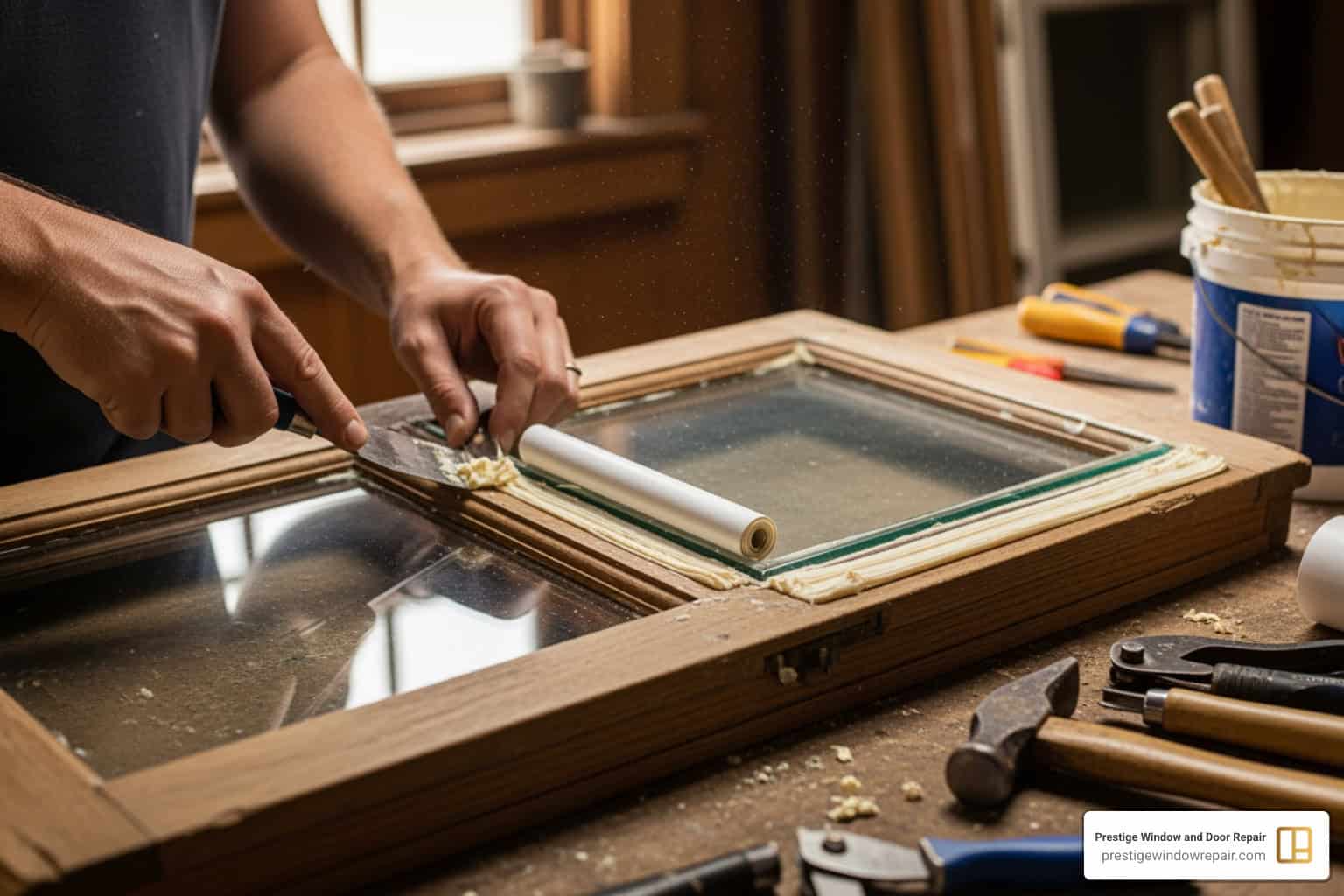
Glazing Compound Application and Tooling
In wood-sash windows, the glass does not just sit in a channel. It is sealed into the sash with glazing compound, a putty-like material that creates a weatherproof bond between the glass and the wood.
Applying glazing compound correctly is one of the more hands-on skills in traditional window glass repair, and it is one where the difference between a professional finish and a DIY attempt is often visible from a distance.
The compound is applied in a rope around the perimeter of the glass after the pane has been secured with glazier’s points. It is then tooled smooth at a consistent angle using a putty knife, creating a neat angled bead that sheds water away from the glass and frame joint. The tooled face should be smooth, uniform in angle, and have clean transition points at the corners.
The quality of the compound itself matters alongside the application technique. Oil-based glazing compounds remain workable for longer and adhere to wood more durably than some water-based alternatives.
The compound needs to be kneaded to a workable consistency before application, applied at the right thickness, and tooled before it begins to skin over. Getting that sequence right requires practice and timing awareness that comes from repetition.
Once the compound has cured, it needs to be primed and painted to protect it from UV degradation, which causes cracking and hardening over time. A properly maintained glazed window, with the compound kept sealed under paint, can have a very long service life.
For a full picture of the reglazing process and how it applies to older wood windows, the post on timber troubles with awning windows covers the frame and glazing relationship clearly.
Sealant Application for Vinyl and Aluminum Frames
Vinyl and aluminum window frames hold glass using glazing beads rather than compound, but the seal between the glass and the frame is still critical for performance.
In these frames, professional window glass repair involves setting the replacement glass on the correct size and hardness of setting blocks, ensuring the glass is centered within the frame opening, and replacing the glazing bead with a clean snap fit.
Many vinyl and aluminum frames also use a structural sealant applied to the inside face of the glazing bead before it is snapped into place.
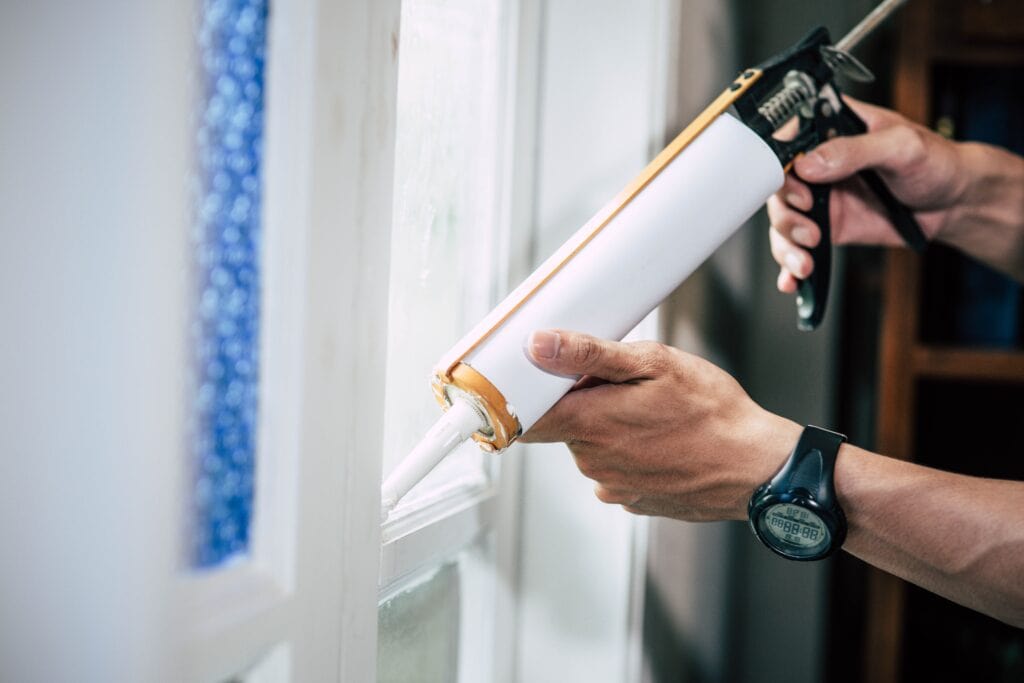
This sealant, typically a neutral-cure silicone compatible with the frame material, creates an additional seal that prevents moisture infiltration along the bead edge. The bead profile needs to be applied consistently, and any excess cleaned before it cures.
Getting the setting block position right is a detail that affects how long the repair holds. Setting blocks support the glass within the frame and prevent direct glass-to-frame contact.
If they are positioned incorrectly or omitted, the glass carries its own weight at the bottom edge, which creates edge stress and can lead to cracking over time. A professional places them at the correct position relative to the corner of the glass, which distributes the load properly.
For sidelight panels adjacent to entry doors, which are a common location for window glass repair due to their high-traffic exposure, the detailed considerations around this kind of work are covered in the post on why you should don’t let a crack develop unchecked in a sidelight.
The Standard That Makes a Repair Last
Across all of these techniques, the common thread in professional window glass repair is that every step is done in service of a result that holds up over time, not just a result that looks acceptable on the day. Resin that fully cures.
Glass that is cut clean and fitted accurately. Glazing compound that is applied at the right thickness and tooled to the right angle. Setting blocks placed correctly. Sealant applied consistently.
Prestige Window Works brings that standard to every window glass repair job, whether it is a straightforward single-pane replacement or a more involved restoration of an older wood-sash window with multiple panes.
For homeowners in the New Rochelle area who want to understand the full range of what professional glass and window work involves locally, the post on New Rochelle doors and windows repair is a useful reference.
Frequently Asked Questions (FAQs)
1. What Is the Difference Between Resin Injection and Full Glass Replacement in Window Glass Repair?
Resin injection stabilizes and seals a crack or chip in a single pane of glass without removing the glass. It works for small, contained damage in standard annealed glass where structural integrity can be restored.
Full replacement is needed when the crack has spread too far to stabilize, when the glass type does not support resin injection such as tempered glass, or when the pane has broken into multiple pieces.
2. Can Professional Window Glass Repair Make a Crack Completely Invisible?
Resin injection significantly reduces the visibility of a crack and restores a good level of optical clarity, but it rarely makes a crack completely invisible, especially in direct sunlight at certain angles.
The goal of the technique is structural stabilization and moisture sealing, with visual improvement as a secondary benefit. For full visual clarity, pane replacement is the appropriate solution.
3. Why Does the Quality of the Glass Cut Matter for a Repair?
A cleanly cut glass edge has minimal micro-fractures along its perimeter. These fractures, when present from a poor cut, become stress concentration points under thermal and mechanical load.
Over time, edge cracks can originate from these points. A properly cut and smoothed edge starts the pane’s service life with the best possible structural condition at its most vulnerable point.
4. How Long Does Glazing Compound Take to Cure Before Painting?
Oil-based glazing compound typically takes between one week and several weeks to form a firm skin that can accept paint, depending on temperature and humidity.
Painting too early traps solvents and can cause the compound to remain soft or develop bubbles under the paint film. A professional will advise on the appropriate wait time based on the compound used and the weather conditions at the time of the job.
5. What Happens If Setting Blocks Are Not Used in a Window Glass Repair?
Without setting blocks, the glass sits directly on the bottom of the frame channel and carries its own weight through glass-to-frame contact.
This creates concentrated stress at the bottom edge of the glass, which can lead to edge cracking over time. Setting blocks distribute the glass weight correctly and prevent direct contact between the glass edge and the harder frame material.
Let our on-site experts handle all your repair and replacement needs!
other posts
Sliding Glass Door Repair: Fixing Sticking Tracks, Broken Rollers, and Misalignment
Sliding glass door repair starts with knowing what's causing the problem. Learn what's behind sticking tracks, worn rollers, and misalignment.

Window Pane Replacement: How Single-Pane Damage Can Be Fixed Without Replacing the Entire Window
Window pane replacement doesn't mean replacing the whole window. Learn when the frame stays put and what the full repair process looks like.
Timber Troubles? How to Repair Your Awning Windows
Solve your awning window troubles! Get expert awning window repair in Greenwich, CT - follow tips, diagnose issues, and fix operators, hinges & sashes.
Glazier Near Me: What a Professional Glazier Does and How They Restore Damaged Windows
Searching for a glazier near me? Learn what professional glaziers actually do, how their work differs from general repairs, and what to look for locally.
How to Reglaze Windows Without Losing Your Mind
Learn to reglaze old windows like a pro: tools, step-by-step process, oil-based compounds & tips for energy efficiency and longevity. Book window reglazing in Rye, NY.